
Overview
The article underscores the critical cybersecurity solutions that organizations must implement to achieve regulatory compliance and adeptly navigate the intricacies of complex regulations. It asserts the necessity of a unified approach, exemplified by JSOC IT's 'Post-Security' model, which seamlessly integrates IT operations, protective measures, and compliance efforts. This integrated strategy not only enhances incident response capabilities but also ensures strict adherence to pivotal regulations such as:
- GDPR
- HIPAA
- CCPA
Introduction
In an era where cyber threats are increasingly sophisticated, organizations confront the formidable challenge of safeguarding their data while complying with a multitude of regulatory requirements. This article explores ten essential cybersecurity solutions that empower businesses to adeptly navigate the intricate landscape of regulatory compliance.
As companies endeavor to strengthen their defenses, the pressing question arises: how can they ensure robust protection while adhering to stringent compliance standards?
This examination unveils the critical strategies and tools necessary for organizations to protect their information and uphold trust in a rapidly evolving digital landscape.
JSOC IT: Integrated Cybersecurity Solutions for Regulatory Compliance
JSOC IT distinguishes itself in the cybersecurity arena with its innovative 'Post-Security' model, which seamlessly integrates IT operations, protective measures, and compliance into a cohesive framework. This holistic strategy effectively dismantles silos, empowering organizations to scale confidently while maintaining against breaches. By embedding their services within client teams, JSOC IT markedly enhances incident response times and bolsters overall trust, positioning itself as a reliable partner for businesses in highly regulated sectors, such as financial services and healthcare.
Experts underscore the necessity of a unified protection framework, emphasizing that traditional defense boundaries are increasingly inadequate against agile, socially-engineered threats. The 'Post-Security' model not only addresses these challenges but also provides cybersecurity solutions for regulatory compliance, enabling organizations to navigate complex regulatory landscapes with greater efficiency. Successful implementations of this model have demonstrated measurable improvements in protective posture, with clients reporting reduced incident response times and heightened readiness for cybersecurity solutions for regulatory compliance.
Recent advancements in the cybersecurity landscape further highlight the relevance of the 'Post-Security' model. The rise of sophisticated threats, such as the HybridPetya ransomware capable of circumventing UEFI Secure Boot, underscores the urgent need for integrated protective solutions that can adapt to evolving risks. By prioritizing collaboration and customization, JSOC IT's approach ensures that businesses are not only shielded but also positioned for sustainable growth within a secure environment. Their commitment to delivering tailored cybersecurity solutions for regulatory compliance directly addresses specific protection needs, thereby enhancing compliance and risk mitigation while providing reassurance for organizations.

General Data Protection Regulation (GDPR): Essential Data Protection Compliance
The General Data Protection Regulation (GDPR) mandates rigorous for entities managing the personal information of EU citizens. It is essential to secure explicit consent for information handling, ensure data portability, and implement robust protective measures to safeguard personal details.
JSOC IT empowers organizations to meet these requirements through its cybersecurity solutions for regulatory compliance, which include comprehensive advanced security measures such as encryption and strict access controls. Additionally, organizations are required to appoint a Data Protection Officer (DPO) to oversee compliance efforts.
JSOC IT's customized approach ensures that businesses use cybersecurity solutions for regulatory compliance to not only comply with GDPR but also to fortify their data against emerging cyber threats. Non-compliance can lead to significant fines, underscoring the necessity of adhering to GDPR for businesses operating in or with the EU.

Health Insurance Portability and Accountability Act (HIPAA): Healthcare Compliance Standards
The Health Insurance Portability and Accountability Act (HIPAA) establishes national standards for the . Covered entities are required to implement comprehensive administrative, physical, and technical safeguards to uphold the confidentiality, integrity, and availability of electronic protected health information (ePHI).
A robust HIPAA adherence program is contingent upon regular risk evaluations and ongoing staff training—both crucial for identifying vulnerabilities and ensuring compliance with regulations. As of 2025, the consequences of non-compliance have intensified, with civil penalties ranging from $13,785 to $68,928 per violation, and maximum fines soaring up to $1.5 million annually per violation category. Organizations that neglect compliance not only face significant financial repercussions but also jeopardize their reputation and trustworthiness.
Best practices for HIPAA adherence encompass:
- Fostering a culture of security awareness
- Conducting regular audits
- Ensuring all staff are thoroughly acquainted with privacy policies and procedures
Essential safeguards mandated by HIPAA include:
- The encryption of ePHI
- Secure access controls
- Incident response plans designed to mitigate potential breaches
In an evolving healthcare landscape, adherence to HIPAA transcends mere regulatory obligation; it is a fundamental component of safeguarding patient information and cultivating trust in healthcare systems.
At JSOC IT, we emphasize a comprehensive compliance framework that integrates effective risk management strategies and insights gleaned from incident response, offering cybersecurity solutions for regulatory compliance to empower healthcare entities in protecting patient information while adhering to HIPAA, HITRUST, and FDA standards.

Payment Card Industry Data Security Standard (PCI DSS): Safeguarding Payment Information
The Payment Card Industry Security Standard (PCI DSS) establishes critical security requirements for organizations managing cardholder information. These requirements include:
- Maintaining a secure network
- Implementing robust access control measures
- Conducting regular monitoring and testing of networks
Compliance with PCI DSS is not merely a legal obligation; it is an essential strategy that involves implementing cybersecurity solutions for regulatory compliance to protect customer information and mitigate the risk of data breaches. As highlighted by industry experts, effective adherence can significantly reduce vulnerabilities. For instance, organizations that have successfully adopted PCI DSS requirements report strengthened protection measures and improved incident response capabilities.
However, achieving compliance presents challenges, particularly for companies navigating the complexities of evolving safety standards and the need for cybersecurity solutions for regulatory compliance. The recent updates to PCI DSS underscore the necessity of , which, while resource-intensive, are crucial for safeguarding sensitive payment information. By prioritizing adherence to regulations, companies not only fulfill legal requirements but also foster customer trust and loyalty, ultimately promoting sustainable growth in a secure environment.

NIST Cybersecurity Framework: Enhancing Cybersecurity Practices
The NIST Cybersecurity Framework offers a robust, risk-based methodology for managing cybersecurity risks, structured around five essential functions:
- Identify
- Protect
- Detect
- Respond
- Recover
This framework empowers organizations to evaluate their cybersecurity posture, identify vulnerabilities, and implement targeted improvements. By adhering to NIST standards, companies not only bolster their regulatory initiatives but also significantly enhance their cybersecurity solutions for regulatory compliance against the ever-evolving landscape of cyber threats.
Organizations that have embraced the NIST Cybersecurity Framework report measurable enhancements in their risk management practices, showcasing a proactive approach to safeguarding their digital assets. Moreover, the integration of specific policies, such as the Vulnerability and Patch Management Policy and the Data Retention and Disposal Policy, is vital for cultivating a culture of compliance and resilience, particularly through the implementation of cybersecurity solutions for regulatory compliance in the face of escalating cyber risks.
The persistent threats, including the , underscore the urgency for enterprises to adopt the NIST Cybersecurity Framework to effectively protect their digital assets. By leveraging insights gained from incident response and implementing effective risk assessment strategies, organizations can significantly elevate their cybersecurity posture and ensure robust protection against potential vulnerabilities.

SOC 2: Ensuring Data Security and Privacy for Service Organizations
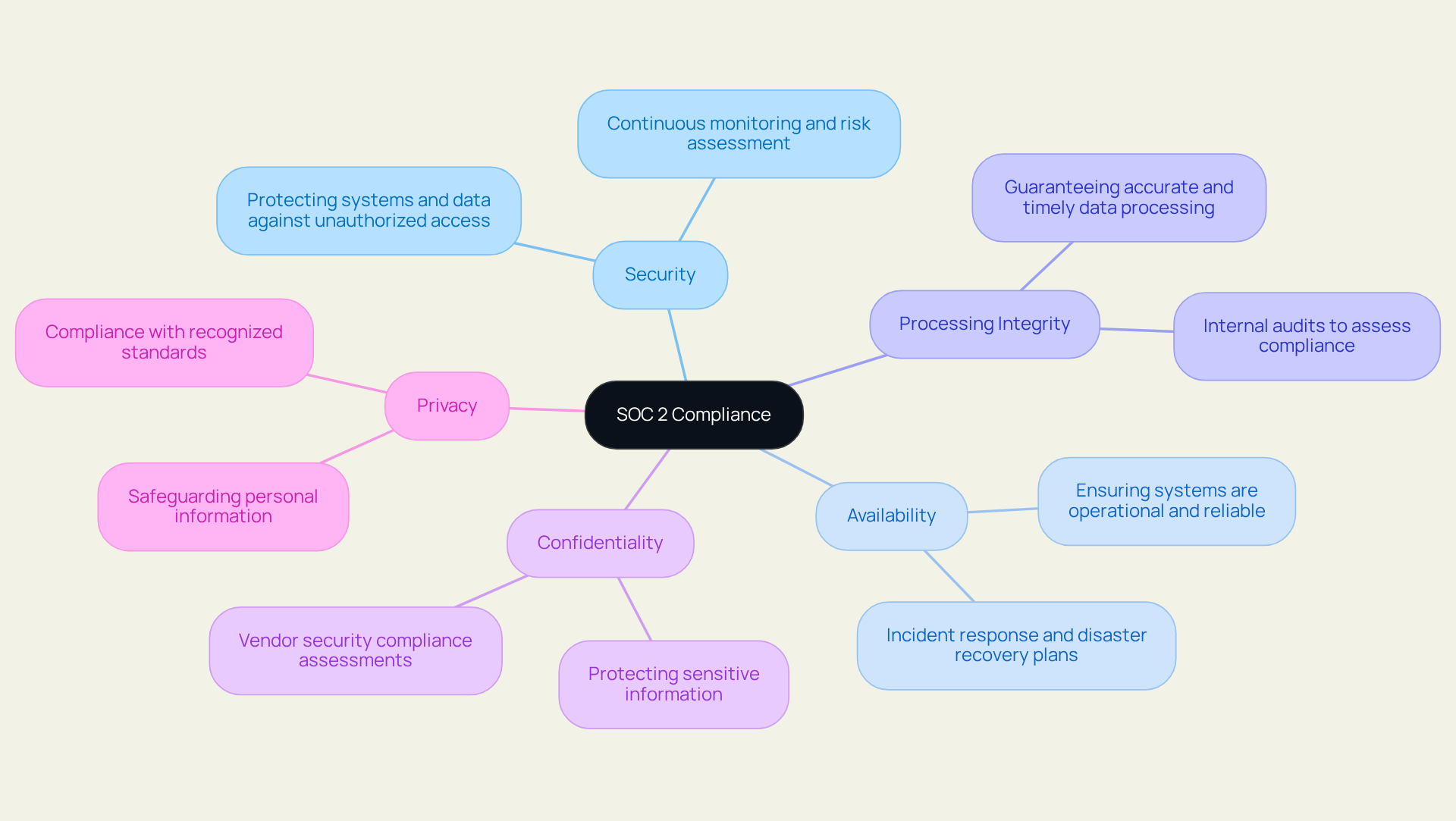
SOC 2 compliance is fundamentally anchored in five essential Trust Services Criteria:
- Security
- Availability
- Processing Integrity
- Confidentiality
- Privacy
Organizations must implement and adhere to rigorous cybersecurity solutions for regulatory compliance to satisfy these criteria. A SOC 2 report serves as definitive proof to clients that their data is managed with the utmost level of protection and responsibility. Achieving SOC 2 adherence not only fortifies a company's protective framework but also cultivates trust and assurance among clients, which are vital components of cybersecurity solutions for regulatory compliance in today’s digital landscape. This commitment to elevated standards of protection and compliance is increasingly recognized as a distinguishing factor in competitive markets, underscoring the for service providers striving to safeguard sensitive information and maintain customer loyalty.
ISO/IEC 27001: International Standard for Information Security Management
ISO/IEC 27001 establishes a robust framework for managing sensitive information, ensuring its confidentiality, integrity, and availability. To achieve certification, organizations must implement an Information Protection Management System (ISMS) that encompasses comprehensive risk assessments, integrated protective measures, and continuous improvement processes. Complying with ISO/IEC 27001 not only fortifies data protection but also signals a strong commitment to information security to clients and stakeholders.
As Shirish Bapat notes, many organizations have found the transition to ISO/IEC 27001 to be enlightening, revealing previously unnoticed vulnerabilities and offering a critical opportunity for enhancement. Essential components of an effective ISMS include:
- Defining the scope of security measures
- Identifying risks and opportunities
- Setting measurable security objectives
Clause 5 underscores the importance of senior leadership demonstrating accountability for the ISMS, emphasizing leadership's pivotal role in the implementation process. This structured approach is vital for organizations aiming to navigate the complexities of modern cybersecurity challenges by utilizing .
Organizations must transition to ISO/IEC 27001:2022 by October 31, 2025, underscoring the urgency of compliance efforts. Notable organizations that have successfully established ISMS for ISO/IEC 27001 compliance have reported significant improvements in their security frameworks, illustrating the standard's crucial role in fostering a culture of security and resilience.
At JSOC IT, we empower companies with integrated cybersecurity solutions for regulatory compliance, specifically tailored for the financial and healthcare sectors, ensuring protection of sensitive information.

Cybersecurity Maturity Model Certification (CMMC): Defense Sector Compliance
The Cybersecurity Maturity Model Certification (CMMC) stands as a crucial framework designed to enhance cybersecurity within the defense industrial base. Beginning November 10, 2025, adherence to CMMC requirements will be obligatory for all Department of Defense (DoD) contractors. This mandates the implementation of specific protective measures and protocols aimed at .
The CMMC framework is organized into multiple levels, each increasing in complexity and requirements for cybersecurity maturity. For example:
- Level 1 emphasizes the fundamental safeguarding of Federal Contract Information (FCI).
- Level 3 focuses on the advanced protection of Controlled Unclassified Information (CUI) against sophisticated threats.
Attaining CMMC certification transcends mere regulatory compliance; it is vital for organizations seeking cybersecurity solutions for regulatory compliance to secure contracts with the DoD and sustain a competitive advantage in the defense sector. Noncompliance may result in severe consequences, including contract disputes and potential liability under the False Claims Act.
As the cybersecurity threat landscape evolves, the CMMC framework is designed to ensure that defense contractors are equipped to confront these challenges effectively, thereby enhancing the overall resilience of the defense sector.

California Consumer Privacy Act (CCPA): Protecting Consumer Privacy Rights
The California Consumer Privacy Act (CCPA) empowers California residents with extensive rights concerning their personal information. Key provisions require businesses to:
- Transparently reveal their information collection practices.
- Facilitate consumer opt-outs from sales of personal information.
- Implement robust security measures to protect personal information.
Organizations must recognize that compliance with the CCPA is not merely a legal obligation but a critical component of maintaining consumer trust and protecting their reputation. Non-compliance can lead to significant financial penalties, with fines reaching up to $7,500 for willful violations, as evidenced by the $1.2 million settlement Sephora faced for failing to provide a 'Do Not Sell My Personal Information' link on its website.
Furthermore, the California Privacy Protection Agency (CPPA) has intensified enforcement actions, underscoring the importance of adhering to CCPA requirements. Consumers are granted rights such as:
- The ability to know what information is collected.
- The right to opt-out of information sales.
- The right to request deletion of their details.
These rights improve , reflecting a broader shift towards greater accountability in information handling practices. As organizations manage the intricacies of CCPA adherence, they must prioritize transparency and consumer rights to build trust and reduce the risks linked with breaches and regulatory infractions.
At JSOC IT, we offer cybersecurity solutions for regulatory compliance that are integrated and customized to meet the unique regulatory requirements of different industries, ensuring strong protection against evolving cyber threats while adhering to regulations such as the CCPA.

Comprehensive Compliance Strategy: Navigating Cybersecurity Regulations
A robust adherence strategy is crucial for navigating the intricate regulatory landscape with cybersecurity solutions for regulatory compliance, particularly in the healthcare sector, where the protection of patient data is of utmost importance. Organizations must initiate this process by conducting comprehensive risk assessments to identify vulnerabilities and implement cybersecurity solutions for regulatory compliance that align with HIPAA, HITRUST, and FDA standards.
The U.S. Department of Defense underscores the necessity of a proactive approach to risk management, which is vital for ensuring adherence and resilience against evolving threats. Collaboration among departments is imperative; integrating regulatory efforts into daily operations fosters a culture of accountability and transparency.
Regular training and awareness programs equip employees with the essential knowledge to effectively adhere to regulatory requirements. NIST emphasizes that employee training is critical, especially given the prevalence of phishing attacks in sectors like healthcare.
Cybersecurity leaders assert that embedding adherence into the organizational framework not only meets regulatory obligations but also significantly strengthens the overall cybersecurity solutions for regulatory compliance. By adopting a proactive strategy, organizations can transform adherence from a mere obligation into a strategic advantage, enhancing their resilience against shifting threats.
To , organizations should institute regular training sessions and audits, ensuring that all employees are prepared to navigate the regulatory landscape while adeptly managing the risks associated with sensitive data.

Conclusion
The significance of integrated cybersecurity solutions for regulatory compliance is paramount, particularly in today's fast-paced digital landscape. By adopting a holistic approach, organizations can effectively safeguard sensitive information while adeptly navigating complex regulatory requirements. The 'Post-Security' model pioneered by JSOC IT exemplifies this strategy, providing tailored services that enhance incident response and cultivate a culture of compliance across diverse sectors.
Throughout this article, we have explored key frameworks and regulations such as:
- GDPR
- HIPAA
- PCI DSS
- CCPA
Each underscoring the necessity of robust cybersecurity measures. The insights presented illustrate how organizations can not only fulfill compliance obligations but also bolster their overall security posture. By implementing advanced security protocols, conducting regular training, and fostering collaboration, companies can significantly enhance their preparedness against cyber threats.
Ultimately, the call to action is unmistakable: organizations must prioritize the integration of cybersecurity solutions into their compliance strategies. As threats continue to evolve, proactive measures will be essential for protecting sensitive data and maintaining trust with clients and stakeholders. Embracing comprehensive compliance strategies will not only mitigate risks but also position organizations for sustainable growth in an increasingly regulated environment.
Frequently Asked Questions
What is the 'Post-Security' model offered by JSOC IT?
The 'Post-Security' model is an innovative approach that integrates IT operations, protective measures, and compliance into a cohesive framework, enhancing incident response times and overall trust for organizations in regulated sectors.
How does the 'Post-Security' model address cybersecurity threats?
It dismantles traditional defense boundaries, empowering organizations to effectively respond to agile, socially-engineered threats while providing solutions for regulatory compliance.
What industries benefit from JSOC IT's services?
JSOC IT primarily serves businesses in highly regulated sectors, such as financial services and healthcare.
What are the key requirements of the General Data Protection Regulation (GDPR)?
GDPR requires explicit consent for handling personal information, data portability, and robust protective measures to safeguard personal details.
How does JSOC IT assist organizations in complying with GDPR?
JSOC IT provides cybersecurity solutions that include advanced security measures like encryption, strict access controls, and the appointment of a Data Protection Officer (DPO).
What are the penalties for non-compliance with GDPR?
Non-compliance can lead to significant fines, emphasizing the importance of adhering to GDPR for businesses operating in or with the EU.
What does the Health Insurance Portability and Accountability Act (HIPAA) regulate?
HIPAA establishes national standards for protecting sensitive patient information and requires covered entities to implement comprehensive safeguards for electronic protected health information (ePHI).
What are some best practices for HIPAA compliance?
Best practices include fostering a culture of security awareness, conducting regular audits, and ensuring staff are familiar with privacy policies and procedures.
What are the financial consequences of HIPAA non-compliance?
As of 2025, civil penalties for HIPAA violations can range from $13,785 to $68,928 per violation, with maximum fines reaching up to $1.5 million annually per violation category.
How does JSOC IT support healthcare entities in adhering to HIPAA?
JSOC IT emphasizes a comprehensive compliance framework that integrates effective risk management strategies and offers tailored cybersecurity solutions to protect patient information while adhering to HIPAA, HITRUST, and FDA standards.